The Formation of the Chinese Communist Party by Yoshihiro Ishikawa
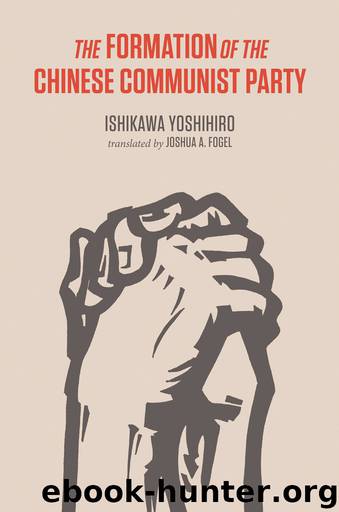
Author:Yoshihiro Ishikawa
Language: eng
Format: epub
Publisher: Columbia University Press
Published: 2013-09-10T04:00:00+00:00
Afterword
This book presents the results of several studies I have written over roughly the past decade. I initially became interested in the history of the formation of the Chinese Communist Party (CCP) in 1988, shortly after entering graduate school at Kyoto University, when I wrote a paper entitled “Chinese Marxism and Japan” (“Chūgoku Marukusushugi to Nihon”) for a graduate seminar on contemporary history. This report began with the extremely simple idea of approaching research into the history of the reception of Marxism, then a burgeoning field in China, from the perspective of the history of cultural interactions based on influences from Japan. I examined the sources of a number of Chinese socialist documents. Although I had studied at Beijing University for two years (1984–1986), I had not been particularly interested at the time in the history of the CCP, and it was with that frame of mind that I proceeded to prepare my essay. It was at that point that I received some unexpected advice. Professor Matsuo Takayoshi of Kyoto Tachibana Women’s College offered his theory, which contradicted the reigning position in China, that the “Yuanquan” who had introduced Marxism in the pages of Chenbao in Beijing was not Li Dazhao. When I examined Professor Matsuo’s arguments and his analysis of related documents, I realized that he was right. He was not a specialist in modern or contemporary Chinese history, but while investigating the exchanges between Yoshino Sakuzō and Li Dazhao during the May Fourth era, he had become aware of this “Yuanquan.”
Thus, all my extensive research turned out to be meaningless because I had unthinkingly followed the commonly accepted thesis in China. When I later examined Chinese magazines and newspapers from the period, it became clear to me that Yuanquan was not Li Dazhao but a reporter for Chenbao by the name of Chen Puxian. Armed with the knowledge that Chen Puxian introduced Marxism to China before Li Dazhao, I then discovered that very little information about Chen Puxian was available in the Chinese scholarly world. Therefore, I was excited that I would be the one to weave together Chinese Marxism, its links to Japan, and the history of the formation of the Chinese Communist Party and bring my master’s thesis, “The Reception of Marxism in the May Fourth Period” (“Goshi jiki ni okeru Marukusushugi no juyō”), to a final conclusion. That was about ten years ago, and it forms the backbone of chapter 1 of this book.
The reception of Marxism in China was, of course, strongly tied to the history of the CCP’s formation, but I was afraid that when I was writing my thesis, this information, which should have been common knowledge, had not been clearly elucidated in proportion to the volume of research already published. Since then I have been fortunate enough to hold a research post, and for the past ten years, I have shifted the focus of my own research from the reception of Marxism to the history of the Chinese Communist Party’s establishment, and I have immersed myself in it.
Download
This site does not store any files on its server. We only index and link to content provided by other sites. Please contact the content providers to delete copyright contents if any and email us, we'll remove relevant links or contents immediately.
| Anthropology | Archaeology |
| Philosophy | Politics & Government |
| Social Sciences | Sociology |
| Women's Studies |
The Secret History by Donna Tartt(19311)
The Social Justice Warrior Handbook by Lisa De Pasquale(12227)
Thirteen Reasons Why by Jay Asher(9009)
This Is How You Lose Her by Junot Diaz(6962)
Weapons of Math Destruction by Cathy O'Neil(6371)
Zero to One by Peter Thiel(5875)
Beartown by Fredrik Backman(5848)
The Myth of the Strong Leader by Archie Brown(5552)
The Fire Next Time by James Baldwin(5508)
How Democracies Die by Steven Levitsky & Daniel Ziblatt(5276)
Promise Me, Dad by Joe Biden(5192)
Stone's Rules by Roger Stone(5133)
A Higher Loyalty: Truth, Lies, and Leadership by James Comey(5020)
100 Deadly Skills by Clint Emerson(4975)
Rise and Kill First by Ronen Bergman(4841)
Secrecy World by Jake Bernstein(4805)
The David Icke Guide to the Global Conspiracy (and how to end it) by David Icke(4776)
The Doomsday Machine by Daniel Ellsberg(4557)
The Farm by Tom Rob Smith(4556)
